No champagne for you!


Can you imagine going past seemingly hundreds of cellar door champagne outlets and not sampling even one of them? Yes? You must be a bloke, because I can’t remember meeting a woman who didn’t drink champagne.

Me, I would have loved to have sampled any number of the many, many types on offer along the Champagne Route, a tourist drive just outside Paris. But I was riding a borrowed motorcycle on the wrong side of the road, so it was No Champagne for Me (with apologies to Sienfeld’s Soup Nazi).

Never mind, it was a great ride. Peter from Yamaha recommended it when I told him I had a few days in Paris with a bike, and it sounded as good as anything else I heard of, so off I went.

I only got a little lost leaving Paris – navigation is difficult when all the signs are in a foreign language (can’t imagine how hard it would be in a country which doesn’t at least use Roman script – I’ve been flying Etihad and Arabic is completely indecipherable).
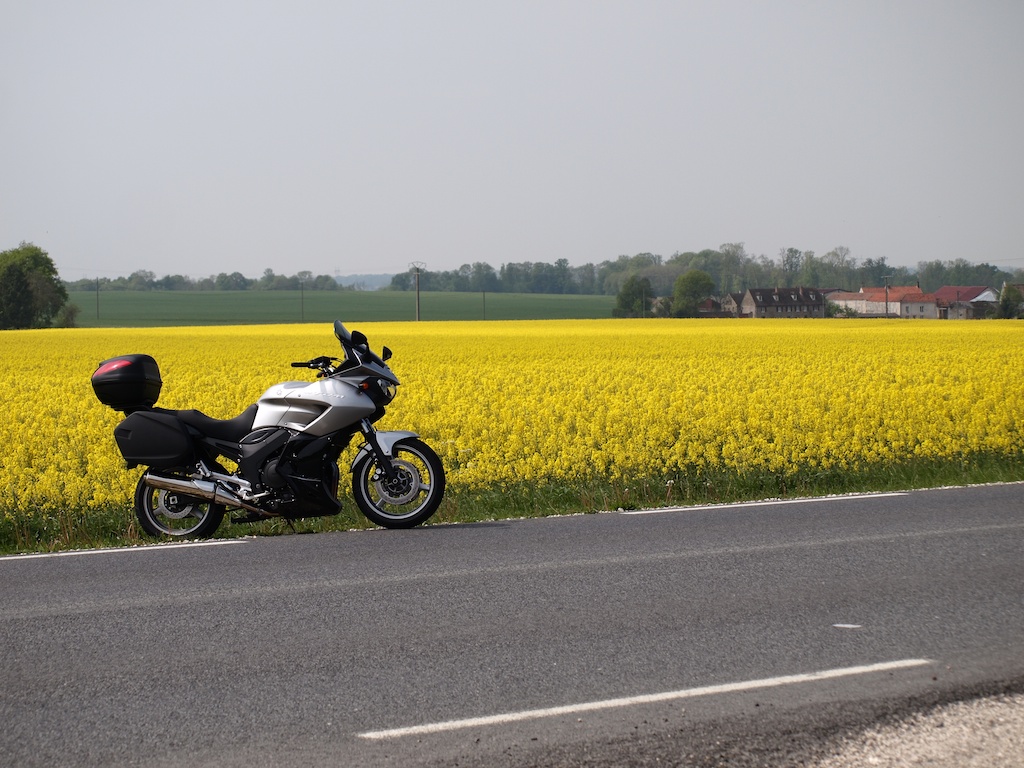
Anyway, back to the champagne: which is actually a region, not a grape or drink, which is why you can’t buy Australian champagne: there’s only one Champagne, and it’s in France. Anything else is sparkling crap, or at least that’s what the French want you to believe. To reinforce that, check the the price of a bottle of Dom Perignon: it should come with four pre-paid hookers and a taxi home it costs so much. I didn’t buy a bottle.

I would have loved to have done the cellar tour at Moet & Chandon, but I physically couldn’t: the blister caused by my boots when I did all the walking to get to Yamaha was giving my absolute hell. I did stop and bought some bandaids, which helped, but the fact it was VE day meant I’d gone nearly all the way to Moet’s cellar before I’d been able to buy any, and by that time walking was hell.

I probably looked like I’d copped a Boche bullet the way I was limping. And it was a small blister. Seriously, I needed a large can of harden the F&@! up…

Anyway, at least the blister didn’t hamper the riding. Awesome stuff around here: French roads are pretty good: there is the occasional bad one, but really they’re few and far between. And while the reputation for French arrogance is probably deserved – but I doubt it’s as bad these days, they seem used to tourists – they can seem to be a bit short and intolerant of anyone who doesn’t speak French.

Then again, they seem to be short with anyone, French speaking or not: I’m not convinced they really single out tourists (and your comments on this matter are welcome below).

Back to the Champagne Route. It’s a fun ride on a bike, lots of twists and turns, although nothing to get your knee down on – more a fun riding road than scratcher’s delight.

There are numerous little towns to pass through along the way, mostly picturesque ancient villages, although there’s some modern developments, which individually look fine, but when they build 100 in the same area, it’s as ugly as any new suburb in Australia, and does spoil the ambience a bit.

Which the French probably don’t give a rats’ arse about. Housing is expensive anywhere, and if building homogenous homes is a way to put a good roof over a lot of people relatively cheaply, upsetting the sensibilities of a Australian tourist isn’t likely to be a major consideration.

Having posted my last blog entry and then gotten lost getting out of town, I was running late, again. So I had lunch in Epernay about 3pm and decided to hit the freeway for the return journey.

A 130km/h limit is a seriously good idea. Flexible policing means 150-160 is the average for big bikes. It’s worth the constant tolls for these speeds…

So by the time I got back to Paris it was getting late. I had a good run back, having decided to stick to the ‘Paris’ signs until I really recognized some landmarks, which would give me the best chance of getting back to my hotel without getting lost en route.

This approach worked, but the landmark was Notre Dame… which is so close to a bunch of other landmarks I decided to stop and photograph them. I think I finally made it back to my hotel about 8pm.

Being VE Day, I assumed there would be some celebrations around the Eiffel Tower, so after a shower I was on the metro (underground trains) and over to have a look. At least by getting rid of the motorcycle boots I could walk again… But there were no celebrations. I hung around for a while and got chatting to a couple of amateur photographers from Germany and Columbia, but essentially the Tower was nothing more special than it usually is.

When the rain started to sprinkle, I decided it was time to find some dinner. But I went the wrong way and ended up in a quiet part of town, so with an aching foot and tired eyes I hit the metro, bought a pizza and took it back to my room and watched a podcast about making eBooks for the iPad. As I type this I’ve just ordered an iPad via WiFi from Abu Dhabi Airport from the apple Store in Australia.

French Roulette


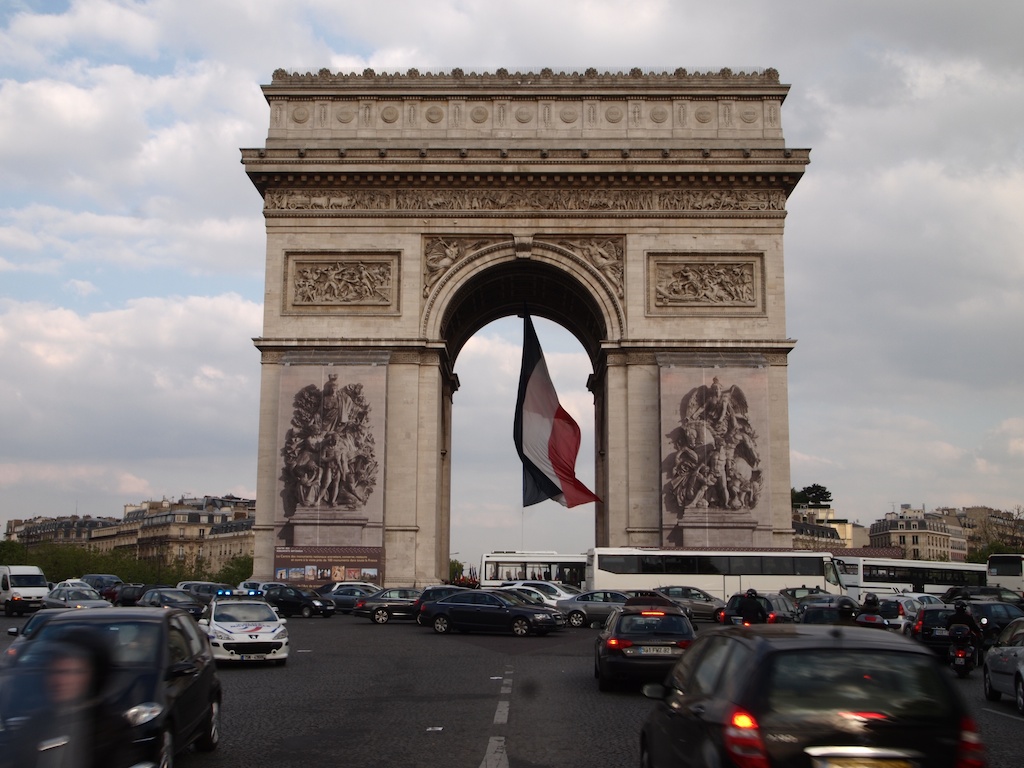
You’ve heard of Russian Roulette, haven’t you? You know, one bullet in the chamber, spin, point the gun at your own head and pull the trigger. One chance in 6 you’ll be dead. We’ll, French Roulette is when a tourist rides around the Arc de Triomphe…

I started my first full day in Paris full of enthusiasm and loose plans to get things done. But by the time I’d posted the blog, had breakfast, found somewhere which said they could wash my clothes (luggage limits meant this wasn’t an option for me) and had wasted time trying to buy a French SIM for my phone (“It does not work. I do not know why,” was the comment from the sales guy. He wasn’t going to try too hard to make it work) it was well past 10.

So I set up a video chat with the family which was a lot of fun (the look on Damien’s face when I told him I’d eaten escargo the night before was priceless), then confirmed with Yamaha the bike I was borrowing would be ready… it was, so into the riding gear and onto the train…

Two trains, one bus and three hours later, having walked so far in my motorcycle boots I’d generated and burst a blister, I was happily in the saddle of a TDM900GT, the GT giving me small panniers, a top box and a lower fairing in addition to the bike we get in Australia. Close to half of the walking was through massive train stations: indeed at one point where a machine would sell me a 5 euro ticket (I didn’t have change, it didn’t take notes and my credit card wasn’t acceptable) I had to walk back at least half a kilometre to find a machine which would take notes… and back again. That’s frustrating.

I then got lost.

I knew this would happen and I didn’t really care, indeed, I was treating it as a tour. There was no hurry and plenty to see, so I just tried to go in the general direction of the city. At one stage I found myself motoring slowly through sections of Paris where the poor people live, with tight streets, run-down housing and kids who could use new shoes… and then minutes later it was mansions on large (by Parisian standards) blocks of land. Indeed, these houses looked like they had been built on a park a long time ago. In typical Paris style they were tall rather than sprawling, but I think if you buy a free-standing house in Paris, you’re rich. Not Packer style rich, but so far in front of other Parisians it’s not funny.

My accidental tour ended at the Arc de Triomphe. By this time I was getting tired of riding, but I was well-attuned to the attitudes of French riders and drivers. Basically, everyone wants to get where they’re going with the least amount of fuss, so no-one bats an eyelid at anyone on two wheels carving up the traffic. Indeed, you’re considered a little strange if you don’t.

I can’t say I ever really felt comfortable pulling over into lane of on-coming traffic and shooting up beside the line of stopped cars on my right, pulling back into the lane as vehicles started coming toward me. But locals do it all the time.

Anyway, back to the Arc. It’s a roundabout where 10 or 11 roads come together. Seriously. And what you end up with is about five lanes of traffic on the roundabout all happily carving up their compatriots in an effort to get where they’re going.

And with no linemarkings, it’s a free-for all which works. People look out for each other because they don’t want to crash. No one I saw was going very fast and it’s becomes just a tangle of vehicles all making their way.

I loved it. With no linemarkings and the only rule being ‘don’t collide’, the car drivers just steadily go where they want and the two wheelers go around them.

If this roundabout were in Australia it would be covered in lanes, signs and traffic lights. It would take 10 times longer to get through and wouldn’t prevent any accidents.

Being May 7, there was also a commemoration of the unknown soldier going on under the Arc, so there were cops everywhere, tourists watching from the outside rim, but there was no way Paris was going to stop motorists using the roundabout: I reckon gridlock would happen pretty quickly if they ever did.

I stopped and walked around the roundabout (not allowed on it today…) and it’s certainly an impressive structure.

From there it was back to the hotel, shower and back on the metro and into town for dinner: French Onion Soup followed by boeuf bourguignon (French beef casserole). It was so good I ate too much.

Snails, steak & brulee


I went with the snails, but the memory of Rowan Atkinson as Mr Bean and the episode of the steak tartar meant I went for cooked version: and very good it was, too.

A wonderful little Sydney restaurant, sadly closed now I believe, The Little Snail, served wonderful escargo, better than la place, where I’m sitting right now, within view (just) of the Eiffel Tower.
But the steak was excellent. With the exchange rate at 70 Euro cents to the dollar, not bad value either: you be hard Pressed to eat in Sydney as well for the money.
The Saint Emilion red wasn’t bad, but at $10 a glass it should have been good. It tasted like a shiraz to me.
Shame they had the price wrong on the bill, overcharging €6 if I hadn’t noticed. Given I took the two course deal and not the three course charged for, i won’t fly off the handle.
Don’t know where all the arrogant, insufferable Frenchies are yet: I haven’t met any.
Damn, the price was right – sort of. The €18 price is only at lunch: the €24 price is dinner, but it includes dessert.
So I’m having a creme brûlée I don’t need.

It’s a busy place: after 10.30 and there’s a steady steam of people still coming in for coffee and drinks. The dinners have slowed, but there’s still a nice vibe to la place.
Paris’ reputation for everyone smoking, walking a dog and making out under every lamppost is no longer true, if it every was.
Smoking seems banned for anywhere indoors – which means I won’t be eating al fresco this trip – and I’ve hardly seen any dogs or making out – only one incident of each, as it turns out, but I suppose there’s still time.
The pistacio brûlée sounds better than it really is: ok but not great. I don’t finish it heading off to the lightshow at the tower.    

Is the Canon EOS 1D MkIV half-baked?


Canon’s EOS 1 range of cameras were the professional standard against which others were judged. Put simply, they are the choice of squillions of working professional photographers, the guys and girls who make a living looking through pieces of glass, who require dependability and high performance in every respect.

Some would argue the range peaked with the EOS 1D MkIIN, at least in the digital realm. Since then the 1D MkIII was released and plagued by a reputation for poor autofocus. Various fixes were instigated by Canon, seemingly with some success, but the simple fact was Nikon had released its D3 and was stealing the march on Canon.

I own a MkIIN and have used the MkIII, and to be honest I thought the MkIII focussed faster, locked on better and was more consistent than my MkIIN. But with these cameras costing $6000 (in Australia) I wasn’t about the upgrade on a whim, especially considering I only shoot professionally for about one day a week – I’m a publisher and the photography is important, but it’s not the only thing I do.

From a specifications point of view the jump to the Mk III wasn’t that great either – 25% more pixels, 10 frames per second instead of 8.5, a better screen on the back, a lighter battery and tweaks to the user interface definitely made it a better camera, but not better enough.

Now we have the 1D Mk IV: 16MP, 10fps, revised autofocus and movie mode. Those specs sound pretty good: I’m always scratching around for a few more pixels, 10fps is enough without being that impressive these days and now I’m making vodcasts for Cycle Torque (www.cycletorque.com.au) movie mode is basically essential. But looking a little deeper into the specifications makes me think Canon has dropped the ball a little on this one, for the Mk IV doesn’t show the forward-thinking and innovation I expected.

Firstly, it still has the 1.3x crop factor, something we’ve had to deal with since the 1-series went digital. When the first 1D was introduced the technology to mass produce a 24x36mm sensor at anything like an affordable price (if you call the close to $6500US launch price affordable at the time) didn’t exist, so the sensor was built a little smaller. Canon used an even smaller sensor, one with crop factor of 1.6x, in its range of consumer and ‘prosumer’ cameras, and does to this day. The smaller sensor, though, is supported by a range of lenses which are specifically designed and built for it and cannot be used on the full-frame cameras (5D, 5D mkII, 1Ds range). There’s nothing specific for the 1D range and its 1.3x sensor, you have to use the sensors for full-frame cameras – which would be fine, but it screws up the focal lengths of your lenses, especially your wide angles.

My widest zoom runs to 17mm. On any 1D (not 1Ds) it’s effectively 22mm, which isn’t ultra-wide. My 24-105mm f/4, on a 1D, becomes 31-136. Zooms of that range have been built in the past, but a little wide to not very long isn’t half a useful as wide to short telephoto. I’ve also owned three of the 1.6x crop factor Canons, and it was a joy to buy the 10-22mm zoom to once again have a genuine wide-angle lens again (the 10-22 is effectively 16-35 when the crop factor is taken into account).

Truth be told, those two lenses (the 17-35 and 24-105), in particular, feel better suited to the 5D MkII, with its full-frame sensor. On the 5D the 24-105 can often cover every focal length you need, but with the 1D I almost always need to carry two lenses. They never felt ‘right’ on the 1D. In the 1D’s defence, though, long lenses get longer, which is great when you’re photographing a small object (a motorcycle) travelling at high speed (they do over 300km/h at Phillip Island). So my 300 f/2.8 becomes 390mm – and as anyone who has used both will attest to, the 300 is a lot easier to use than the 400mm f/2.8, which weighs about 3 ton more.

So I was hoping the next generation of 1D would have a full-frame sensor, but it doesn’t. Maybe Canon thought it would look like they were copying the Nikon D3 with its 12MP full-frame sensor, but the result is the Mk IV looks like an upgrade of an ageing design rather than anything revolutionary.

An almost essential addition was HD video recording capability: while Canon’s delivered here, it seriously looks like it’s been added in as an afterthought or extra feature rather than a design which points to a merger of the two mediums (stills and video). There’s still no effective autofocusing, going to movie mode isn’t intuitive or quick and the new camera doesn’t even have the full manual control being offered to owners of the 5D MkII soon via a new firmware update. According to DP review shooting video with the MkIV isn’t as simple as on the much cheaper 7D. One very important update to the 5D’s firmware is the addition of audio meters, something the MkIV doesn’t have.

I was expecting so much more. Where’s the XLR audio input, or at least an optional extra to provide professional audio? Where’s the full full set of controls the cheaper 5D will have for audio in a couple of weeks? Where’s the full-frame sensor? Where are the lenses built for video to go with these cameras with their own autofocusing ability?

For the hard-core professional sports photographer, the Canon EOS 1D Mk IV will almost certainly be the best sports camera ever produced by Canon. Whether it will prove to be better than what Nikon is offering remains to be seen.

I’ll probably buy one anyway.

My iPad


There has been no end of coverage of the new Apple iPad, and I suppose I’m just contributing to the noise here, but that’s the point of a blog: I can write this and if no one reads it, well, no trees will fall in the forest.

But I’m not going to say who the iPad is for, or if it will revolutionise media or computers or communication. I’m just going to tell you about how I plan to use mine, when I get it (but we all know about best laid plans…).

In no particular order, here’s how I will use it. It will be a photo and video viewer, using the optional camera kit. As a photographer and now videographer, playing back images on the screens which came with the camera is good but not great. You can’t really check focus, exposure is a bit hit-and-miss and compsition looks different on a 3-inch screen compared to a big one. The iPad’s screen is actually bigger than the final use of many images, so I’m sure it will be a big benefit. It’s certainly not the giant leap forward moving from film to digital represented, but I still feel it’s significant.

The iPad will be my travel computer. I regularly travel for motorcycle launches and need to bring back written articles: the iPad, especially when combined with a bluetooth keyboard, will be fine for writing these stories. Apple has shown a word processor, Pages, which will be a US$10 download. I can afford that. The iPad will also do email and web browsing, of course, so that will keep me in touch with the world. I’m hoping it will tether with my iPhone for connectivity through the 3G mobile phone system so I don’t always have to have a Wi-Fi network available… I really don’t want to buy the 3G-equipped version of the iPad and have yet another data plan to pay for, although being unlocked and month-by-month I suppose it won’t be too bad.

It will be frustrating being in a hotel with broadband available via an ethernet cable which won’t, of course, connect to an iPad. For the same reasons the iPad is great for business trips, it will be good on holidays, too. Lighter, easier to pack and carry than a laptop with most of the functionality, it will be handy to have.

The iPad will be the machine I will usually carry between office and home. I have this fantasy I might actually start riding a motorcycle between home and office occasionally (something usually difficult because I pick up my two kids from school after work) and a $750 iPad weighing 750 grams rather than a laptop at 3kg (and which cost $4000) is a much more attractive proposition. I rarely need a computer at home with more power than an iPad and there’s a number of machines there, anyway.

At home I’ll use the iPad to read, maybe listen (iPods and iPhones are probably better for the latter), and to communicate. I’m not a big user of FaceBook, but I can see me uploading more pictures to the site with an iPad rather than a laptop, mainly because I think the process will be more seamless. I will use the iPad for web surfing (something I do quite a lot of in my job) and email at home.

I can also see the TV in the bedroom going, becoming unnecessary. It’s only used about once a month anyway, and I can sit an iPad on my knees. Then again, ripping a  DVD takes quite a bit of time, especially compared to popping one into the player under the TV. But there may also be a way to watch a DVD on the iPad with the disc actually in the Mac Mini in the loungeroom…

Then there’s the apps. I can see the iPad becoming an adjunct to my workstation in the office (laptop, second screen, keyboard and mouse). Instead of bouncing from program to program, I may use the iPad to check stuff online, do calculations etc. I already often do this, reaching for a conventional old calculator rather than firing up the very powerful one built into my Mac (and just a moment ago I used Appbox to work out the metric equivalent to the 1.5 pounds Apple is quoting the iPad’s weight). Screen real estate is like horsepower: too much is never enough.

I’m sure I won’t be the only one using my iPad. The kids love playing with iPhones, and I’m sure the iPad will be even more attractive. There’s a plethora of games available for the iPhone and many more – and expanded versions of existing games – will come to the iPad. They, and the movies, will be great for keeping kids occupied during long journeys (which they believe is anything further than their local school).

I’m also hoping to read magazines on the iPad. Sports Illustrated demonstrated its ideas on how we can consume media on a device like the iPad, and it’s a much richer, more interactive and immersive experience than simply reading a magazine. I’m hoping for versions of National Geographic, Life, Time, Australian Geographic, MacWorld, ProPhoto, Crikey, The Monthly and lots more all to be available on the iPad – and I’m even happy to pay for the content, something people in general (including myself) are reluctant to do on the web. I feel quality media is in decline because people aren’t willing to pay for it in its current forms. Web stories are typically poorly researched, written to ridiculously tight deadlines, are short and shallow and usually aren’t worth the small amount of time it takes to read them.

Esquire on my iPhone is much better. The same content on an iPad would be an even better experience, because the images would be displayed better, the designer would have more scope and the words would be easier to read.

In the short term Apple seems more interested in taking on Amazon’s kindle rather than re-inventing the magazine, but I think they will get around to other forms of media soon enough.

That’s how I plan to use my iPad. It won’t replace my MacBook Pro in my office, but it might just move me off the dining room table of an evening and onto a couch, and I know where I’d rather be.

How Skype could improve the world


Skype Language Learning System is something I hope is being developed (but maybe it’s my idea). It wouldn’t be difficult to develop and would result in the decline of global warming and world peace.

OK, it wouldn’t be that significant. What it would do is help people help each other learning foreign languages. Essentially the Skype Language Learning System would pair up people from all over the world who would then video conference or simply use text chatting to improve their language skills.

What you’d do is register a username and password, then choose the languages you know and the language(s) you want to learn. Skype’s database would show a list of people online who are available to chat and can would then connect you together. If there was no one available who could help you learn Swahili when you logged on you could simply register you Skype phone number with the system to call you when a Swahili-speaking user was available. You might also be able to schedule timeslots with instructors somehow, too.

So, how do you get people to help, to actually instruct? By making it an exchange system. If you spend time as a student, you must also spend time as an instructor, helping people with your own language. Instructors might also earn phone credits they can use making other Skype calls. Skype, of course, earns money from the system because the learner is paying for the call. If you have two learners hooking up to help each other with their respective languages, both could pay for their calls and no credits are earned.

Tying-in the various automated translation sercices shouldn’t be difficult, either, but the greatest feature of Skype Language Learning System is it’s one-on-on video conferencing. See, hear and learn the subtleties which people use when they talk.

The flow-on for this could be huge for Skype. This could be the ‘killer app’ for many people to try – or use – Skype for the first time.

Call me square


There has been a slew of new cameras announced on launched in recent months, but no manufacturer has really launched a game-changer.

Put simply, we still use cameras like we did when their design was as much dictated but the shape and technical requirements of film rather than what’s ideal for us – except we hold them further from our bodies to look at the back of our digital cameras instead of through a viewfinder.

We still put up with rectangular pictures, and in the world of advanced amateurs and professionals, the manufacturers even duplicate controls so the cameras can be used vertically and horizontally. This is downright silly – why not simply have a square sensor and crop accordingly?

A square format – used for decades by Hasselblad even today – would give designers a lot more freedom when it comes to the design of a camera and with the flick of a switch the photographer could change what’s captured from horizontal to square to vertical, a lot quicker than physically rotating a camera.

As an editorial photographer I’d almost always shoot square. I can crop images later in the computer and have the flexibility of creating a horizontal or vertical from each image in post rather than having to decide how I like it when I take the shot – or worse, continually take both!

Until recently it could be argued we didn’t have the megapixels to waste on a square sensor, but we sure do now. My Canon EOS 5D MkII captures over 20MP with a touch of the shutter, almost three times the amount my 1D MkIIN captures – and I’ve produced double-page spreads from the 1D. Sure, they’d look better from the 5D, but they were acceptable for the times.

A square format would require rethinking of camera design though. Video cameras aren’t used vertically, and look how comprehensively different they are to still cameras. Flip-out screens which could be angled to suit the image would be a no-brainer, any built-in flash would always be above the lens where it should be, the camera’s shape could be configured to make shooting from waist-level viable.

I doubt we’re going to see a square-format camera from anybody except Hasselblad. I just don’t think it’s what people are asking for – but I think we’re missing out as a result.